THE SAGINAW AND MANISTEE LUMBER COMPANY STEAM LOCOMOTIVE ROSTER
The following information is an attempt to document the various steam locomotive on the widespread operations of the Saginaw. One of the unique problems of compiling an accurate list is that they purchased new and used locomotives at will and threw leased engines into the cauldron whenever it suited their needs. It may have been a practical choice at the time, however, when it comes to documenting events for posterity it can prove a challenge.
Thus, using the builder's date cannot be used to accurately document when and where a particular engine was employed. Some of the greatest sources of information, like the Lumberjack publication, are at this time lost to research. What has been documented may not be the full story, as engines moved from one line to another, and others introduced as needed. Unlike some larger companies where documents abound along with images from the past, the Saginaw continues to reveal its historical secrets only through steadfast, thorough research and determination.
The following can be considered the most accurate at the time of publication:
No. Type Builder Built Comments
212 2T Shay Lima Unknown Used; 1894-1898 Saginaw Southern. 1899- Challender. 1908-Sold to Mexico, scrapped
556 2T Shay Lima 556 1889 New: 1889-1921 Saginaw Southern, S&M. 1921- Sold scrapped
327 2T Climax Climax 327 1901-02 Saginaw Southern
1 2T Climax Climax 1481 1917 Used; Bellemont and Chalender
1 (585) 2T Shay Lima 585 1899 Used, from Saginaw Lumber Co., Michigan. Saginaw Southern. 1919-to AL&T 1941- Leased to S&M #585, Flagstaff Area
2 2-6-0 Baldwin 23883 1904 New
3 2-6-0 Baldwin 32249 1907 New; Bellemont (Image)
4 2T Shay Lima 2732 1913 Used, 1923; ex AL&T; Possible Bellemont, Garland Prairie. 1929- for sale, scrapped
4(2) 3T Shay Lima 3026 1919 Used, 1941-Leased to S&M Flagstaff line.
4(3) 2-6-6-2 Baldwin 56738 1923 Purchased used 1944. Flagstaff line. To Southwest Lumber #4. Scrapped 1956
5 3T Shay Lima 2905 1917 AL&T #5, to S&M 1941 Flagstaff line. Damaged firebox, 1950 scrapped.
25 2-8-0 Baldwin 35938 1911 Known as 2 Spot, display Flagstaff.
248 4-6-0 Rogers 5285 1898 Used,' 1943: Flagstaff. Scrapped 1948.
105 3T Heisler Heisler 1596 1930 Used; at Allen Lake c. 1955 (Further investigation reveals this was a Southwest Lumber Mills engine, post 1953 after S&M ownership.)
(Note: "T" designates number of powered trucks for geared engines)
(2-6-0 Engines #2, #3 were the only new locomotives that were built by Baldwin. These two engines appear to have been used for a number of years, appearing on several lines.)
(Three engines were leased for Bellemont Line: two 4-4-0s and a 2-8-0.)
(Chart and information Stein; Report #19, page 114. Schuppert, pages 59, 96,97. Shaylocomotives.com/data. Additional information Author's research.)
(Additional engines were in use on the Flagstaff line. A roster is available in Schuppert's excellent book "Central Arizona Railroad," page 96 (out of print.))
(An interesting side note; during research in the company archives, I found a document soliciting a bid on a narrow-gauge Shay. There were no additional notations or specifications, implying that there was no further action taken on the proposal. It does lead one to speculate as to why they were thinking narrow gauge. Could it be that they hoped to connect with the narrow-gauge railroad to Jerome? Were they thinking that a slimmer track would help them navigate the forest terrain, into those difficult and unique stands of timber?)
A SUMMARY OF ENGINES ON THE VARIOUS LINES
Courtesy National Archives, neg. 48-RST-4C-2
SAGINAW SOUTHERN
On the Saginaw Southern Line, south of the Williams mill, two-truck Shays #556 and #212 at work. Both working the line in Barney Flats area, circa 1900. In addition, two-truck Climax #327 was at work in those woods. Like the two Shays, it appears to have the same number as its builder's number.
NORTH CHALLENDER
On the Chalender line, two-truck Climax #1 was at work, and later on the Bellemont line. This would make sense, as research indicates the Bellemont line connected with the Chalender, making it easier to transition equipment from one operation, as it closed down, to the Bellemont. Two truck Shay #1 may also have worked this line, later transferred to the AL&T as #7. Other engines that ran on the line remain a mystery; only further sleuthing will reveal their identity.
BELLEMONT LINE
Three used but serviceable (by logging standards) steam engines were leased to help with the production; two 4-4-0s and one 2-8-0 (Stein, 50.) Two new Baldwin rod-type locomotives were also purchased (Glover 3;1983.) (These would have been purchased in 1904, 1907.) In 1923 It was reported in The LUMBERJACK, the Newsletter published by the Safety and Welfare Committee of the Saginaw and Manistee Lumber Company, that two rod engines, one fifty-ton Shay, and one thirty-five-ton Climax were at work (Volume 1, December 1923, #8. pages 1,6,8)
Saginaw and Manistee loading deck, circa 1922: Engine #3, a Baldwin 2-6-0. Given the date, the location is somewhere on the Bellemont Line. Courtesy U.S. Forest Service.
TUSAYAN
According to the Auditor's Report, authored by C.E. Siddall, for the period of September 1, 1929, to August 1, 1930 (NAU Cline Library Special Collections, MS #84, Box 15 of 15, Taxes and Insurance), Exhibit "A" stated the following inventory was located at Camp 2, assumed to be Apex since it was the Headquarters' Camp in the Tusayan line:
"2 Baldwin Rod Locomotives #1, #2 1 Shay Geared Locomotive #4
1 Climax Locomotive #3 (at Williams) 10 Russel Log Cars
2 Fairbanks Morse Speeders 86 Russel Log Cars (at Williams)
(The Climax #3 and rod Locomotives #1, #2 do not appear on the prior roster in this section.)
Steam engines continued to provide the motive power for the log trains. Three engines were purchased or relocated from other operations: two Baldwin 2-6-0s (road numbers 1 and 2); and one Shay (number 4; Auditor's Report, 1930.) According to the report, engines #1 and #2 were built new for the S&M, probably other than Baldwin.
Once shiny, stout and strong, the work ahead in the woods would be tough and unforgiving. The engine crews would be proud of their iron steeds, keeping them clean and maintained, despite the dusty and muddy environment (An extensive history on these locomotives is located in the book by Al Richmond, The Story of the Grand Canyon Railway, pages 111, 112.)

Although the photographs are not captioned as to their location, it is very possible that these were the two engines abandoned near Apex. Probably Shay #4, and locomotive #2. Both were scrapped in 1941. (Photographs courtesy of Arizona Memory Project: Williams, Arizona Collection. A copy of the original scan is available at the Williams Historic Photo Project, in Williams, AZ.)

...
In the North Country, steam engines powered the logging railroads until the very end of operations. Used locomotives were still available, since the mainline companies were transitioning to diesel power. However, these companies were keen on getting every mile of usefulness out of those steam engines, so finding them in reasonable operating condition was becoming a problem (this is one of the reasons why the Saginaw's 2-6-6-2 was retired, as it was just worn out to justify a rebuild.)
THE DIESEL EXPERIMENT
The Flagstaff area logging companies, which the Saginaw was only one of many, were aware of the eventual need to purchase diesel power. Southwest Forest Industries, after having acquired the Saginaw Flagstaff operations, purchased in 1959 a used Rock Island diesel end-cab switcher, an S-12 built by Baldwin-Lima-Hamilton (the name of the manufacturer was cobbled together from the merger of former steam locomotive builders.)
This particular engine was relatively small and compact, as it was designed for switching duties. However, it proved to be more useful in plowing up track, than motivating down the rails. This was due to the fact that the track was sufficient (just barely) to support steam locomotives, which had independently sprung driving wheels, allowing more flexibility to remain on the rails. The diesel was supported by two rigid frame four-wheel trucks, with marginal lateral movement. The end result was a constant effort to re-rail the oversized paperweight (Schuppert; pages 80,81.) I wonder if this particular S-12 still exists?
SURVIVING STEAM ENGINES


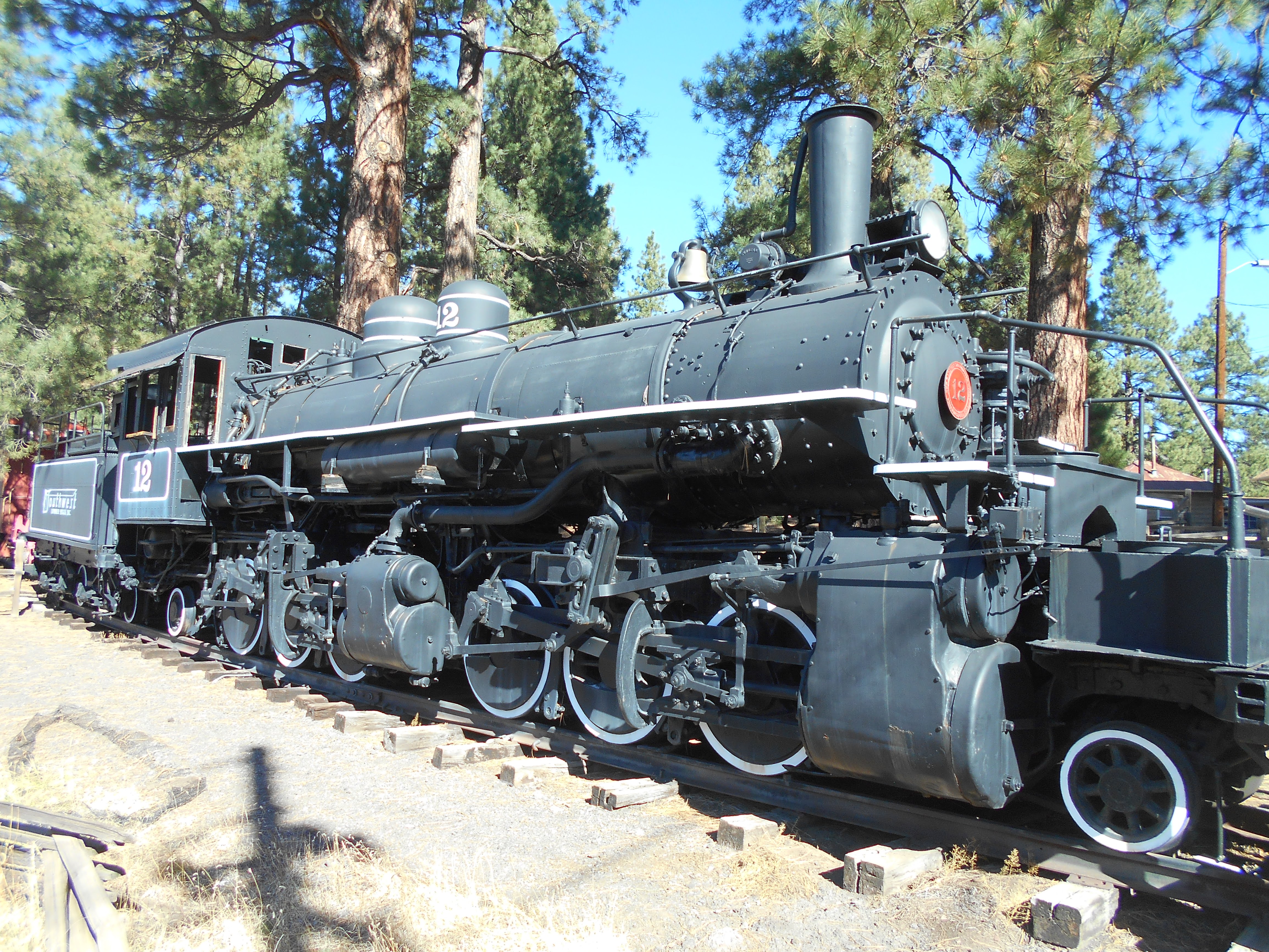
2-6-6-2 #12, Southwest Forest Industries, on display in Flagstaff
Engine #12, the second 2-6-6-2 to operate in the Flagstaff area, was donated to the city of Flagstaff by Southwest Forest Industries. After having been moved to the Pioneer Museum, it is now proudly displayed along the main road. The Pioneer Museum is dedicated to the preservation of the history of early pioneers in the Flagstaff area. This museum has outdoor displays and rotating exhibits located in the main building and is well worth your visit (2340 N. Fort Valley Road, Flagstaff, Arizona; azhs.org/museum/pioneer.)
Saginaw and Manistee engine #4. Image verified in public domain. Author Unknown
Engine number 12 is similar to the original 2-6-6-2 (#4) operated by the Saginaw and Manistee during the Flagstaff years. In October of 1944 the Saginaw and Manistee purchased its' first and only 2-6-6-2 articulated mallet locomotive. Not just any articulate, but a true mallet with high- and low-pressure steam cylinders. It had previously been used in the Pacific Northwest. Later, in 1953, it was sold to Southwest Lumber Mills, until having been scrapped in 1956 (Schuppert, pages 96, 97.)


This survivor is located in Williams, Arizona at the Grand Canyon Railway Station and Hotel complex. This engine is an import from another state; however, it is similar to the three-truck Shay locomotives used by the Saginaw. It is a massive machine, and worth the visit. There are several other steam engines on display at the station. A railroad museum will hopefully be opened in the near future in Williams. Seems every time the opening is announced, another issue arises. Hopefully the influx of real-estate developers will assist in funding the project.
One additional survivor is on display at the Flagstaff Depot. Engine #25, a 2-8-0, Baldwin #35938 (built 1911.) Also known as "#2 Spot." As the story goes, a water bag was hung outside the cab window, and over time the 5 was worn away.
Early image of #25 (Author's Collection.)
#25 On Display in Flagstaff, Arizona. Note the "slope back" or switcher tender; in operation, the engine had a standard tender (see prior image.)
Arcata and Mad River articulated locomotive, pre-Southwest Lumber Mills, Inc. #12
One of my obsessions is to find images of the steam locomotives (and one ALCO diesel switcher) that haunted the woods of the North Country. A good source of information are second-hand images on eBay.
I acquired an original photograph of Arcata and Mad River Railroad locomotive #12. This was part of a collection of images from an amateur rail photographer, who graciously provided written information with each entry. The following is a paraphrased translation:
Arcata and Mad River Number 12, 2-6-6-2T Baldwin 1929- builder number 60870, compound (Mallet).
Ex-Hammond Lumber #60, Mill City, Oregon
Ex-Hammond and Little River, Red (Redding, Ca.?) #12
Ex-Hammond Lumber #12
Leased by Northern Redwood for Arcata and Mad River, 1951.
Purchased by Southwest Lumber Mills, Inc. in 1956.

This was the second articulated locomotive to operate out of Flagstaff and is currently on display at the Heritage Museum in Flagstaff, Arizona. Photograph image author's Collection
Saginaw and Manistee Lumber Company Shay #4
The engine has unusually small lettering: the company name is abbreviated and was probably done at the time that the Saginaw and Manistee leased the Flagstaff operation. The lettering was not corrected to the later font used on other locomotives. Taking a closer look, the engine appears to be out of service, as the side air tank and foot boards are missing. Image was taken outside the mill in Flagstaff, Arizona. Note the unusual windows; according to the source these are known as "Coffin Windows."
Credits:
Kindig, Richard H. Saginaw and Manistee Lumber Co. (SMLC) 4, Photograph June 27, 1946.
The Gateway to Oklahoma History, Oklahoma Historical Society.
Image used as an educational source only. Not for resale or other purposes
Saginaw and Manistee Lumber Company #5, Williams, Arizona 4-25-49.
Leased to Saginaw and Manistee Lumber Co., 3/1943
Credits: Collection of Donald R. Hensley, Jr. 390 Hillcrest Ave-Waynesburg, PA 15370
photos@taplines.net-www.taplines.net
............
The average steam logging locomotive can be said to chug its way through the forest, satisfied to rock about the unballasted rails, glad to have a day in the sunshine. A proud little iron horse: at times prancing yet determined as it goes about its work. An articulated, fire-breathing 2-6-6-2 is not just another steam engine. Such a devising of man thunders, shaking earth and sky, loudly announcing its presence; a majestic form casting broad shadows on the landscape, leaving no one to doubt as to what approaches through the cloud of steam and smoke. Such a spectacle, once witnessed, will always be remembered; awesome to behold; urging even the proudest of men to stand in silence, hat in hand, humbled with respect and admiration. This is no pony; this was an iron-willed stallion at work!
I would also like to compile a collection of photographs for all of the Saginaw engines. This is often hindered by copyright restrictions. If you know where I can get pictures of any or all of them, in the public domain, please send me an email.

%20-%20Copy.JPG)
.JPG)



.JPG)


