Tuesday, October 29, 2024

Recent Thoughts and General Ramblings of a Blog Author

                        Recent Thoughts and General Ramblings of a Blog Author

I have not forgotten or forsaken my beloved Blog on the Saginaw. This has become more than just a historical documentary on a little-known railroad empire. It is now more of a relationship that at times demands my attention. Similar to walking the dog, if you don't do it regularly a mess can result. Or you see a couple of feeding dishes and wonder if you forgot that you have a dog.

Like all of us, other activities must be prioritized and addressed before they become major problems. My old car had 150,000 miles that were filled with adventure and challenges. Like most old things that have served well, it came time to be retired.  Having a new vehicle has once again opened the vast reaches of the national forests to exploration, once again allowing that feeling of anticipation of what new discovery awaits down the forest trail. 

Some of those remote locations can now be traveled with a degree of safety and reliability, avoiding that nagging doubt as to when a breakdown may occur. Remote areas are best traveled with reliable transportation, and oodles of provisions, in order not to become another lost person statistic. Nature is not to be trifled with, nor many of the forest denizens. My hope is now to get out there and find the hidden reaches of the Saginaw. 

I am trying to master the intricacies of the computer, specifically how to get the pages on the blog to do my bidding. I would rather face wildlife than the keyboard of a device that really doesn't care if I can communicate with it. Probably shouldn't say that too loud, as the microwave will serve lukewarm coffee for the rest of my life. Technology one day will rebel. Hopefully I will figure out how pages work, and then I can get to another daunting task in the data verse, like finding my phone that hides in strange places. 

Tuesday, June 18, 2024

Williams Arizona: Vintage Postcards

 Williams Arizona: Vintage Postcards


Although I have recently concentrated on the Saga of the Saginaw, this Blog also covers the history of Williams, Arizona. Someday, after some expert tutelage and earning an advanced degree in computers (or just learning by trial and error), I will reorganize the Blog into two sections. Until then, posts will be forthcoming in random order. After all, would you rather be following a Blog on the personal lives of narcissistic postings, or this one where you can learn something valuable and life-changing (maybe not the latter, but I can hope.)

Today, with the availability of the internet and texting on telephones (even that is becoming an archaic term), anyone can keep in contact with whomever else instantly throughout the world. At one time, communication was a somewhat more complicated process, involving the application of pen or pencil to paper. This was then neatly folded into an addressed envelope, stamped with the appropriate amount of postage, and sent through the mail to the patient recipient.  

 A postcard provided a faster means of communication at a cheaper rate. These simple mailable items were used by virtually anyone who were traveling to communicate with family or friends. A post card, literally a card that can be mailed, even had a reduced postage rate that provided additional incentive for travelers to keep in touch with those left at home. Today, old shoe boxes can be found at yard sales, stuffed full of treasured postcards that once provided the pleasure of old memories that might otherwise have been forgotten. 

Letters and postcards have become an archaic means of communication. Although there are legions of older people (I, being one) who will still use this methodology for all sorts of mischief. 

Studying old postcards can reveal a number of details that might have been otherwise lost to history. Those shoeboxes full of postcards are a valuable source of images and written information that provide clues to our past. The following are several examples that we shall consider in this posting. The two postcards of Williams were subjected to high resolution scans to help with my research. These images, however, are simple pictures of the cards. It seems that someone decided to replace their home printer with another brand that is not connected to the internet (it's just unnatural that a manufacturer can communicate with your printer and update the program without even paying a visit or asking first. Another courtesy that has become archaic.) In so doing, forgot to get a scanning printer; note to self, make list before purchasing a new printer.

"Birds-Eye View Williams, Arizona"
Post dated May 26, 1911.

This old postcard yields a number of secrets. View is looking Southwest, across the Santa Fe yards (which are quite substantial for the time) towards Bill Williams Mountain. The Saginaw and Manistee Lumber Company's mill can be seen in the distance, and from the amount of cut lumber in the yards, is doing well. Upon close inspection, I could make out a structure with a smokestack near the mill. This could be one of the surviving images of the original electric company powerplant, that was located on the lot now occupied by the Dairy Queen (additional information is available in a separate posting). Further research will turn up more tidbits of historical facts.  


"Birds Eye View of Williams, Arizona", Curt Teich and Company, Chicago
Date Unknown

This image is taken from the hill that is directly southeast of Williams. The mill is in the distance; some interesting details can be seen. It is possible that the brewery structure is in the image. Another piece of history waiting for further study. 
 
Lumber Mill at Flagstaff, Arizona. 
Bradshaw's Color Studio, Box 195, Sedona, Arizona
Post dated December 21, 1964


This is an image of one of the private lumber mill operations near Flagstaff. View looks to the East, where Lake Mary will one day fill the valley floor. The distant hill forms a mesa, where one of the logging railroads built a set of switchbacks to reach the top. I included this image because I once visited this area, having no idea that a mill was located on this site. Nothing remains of the mill. Just a nice image of the forest, which has regrown from early logging, and a pastoral scene of the valley floor. 

Thursday, April 25, 2024

Flagstaff Mill: Additional Images

 Saginaw and Manistee Flagstaff, Arizona Mill; Additional Images

One of my recent posts focused on an image of the leased Flagstaff Mill. Additional research has uncovered a number of images from postcards and other sources. The images and postcards were purchased and are in the author's private collection. Where practical, I have included credits as to the original source. 

The two following images reveal a broader perspective of the mill in Flagstaff. In the first image, the big wheel logging cart or wagon is seen across the road, which is old route 66, on the west side of Flagstaff. None of the structures are currently in existence, with the exception of the cart which is now located at the Pioneer Museum. 

Postcard, Author's Collection. Published by Petley Studios, Phoenix Arizona. Photo by Carlos Elmer.

The above image reflects a robust operation at the millsite. A number of log cars, apparently steel fish-belly type flat cars, are at the mill. The Mill itself seems to be humming with activity and is in reasonably kept condition. Weeds seem to be the proper form of landscaping, as it appears in both images.


Postcard: Author's Collection, Published by Bradshaw's Color Studios, Sedona, Arizona. 

The second image shows the cart on the same side of the highway as the mill. A wonderous crop of weeds decorate the site, along with sunflowers, placing this sometime in late summer. The mill is showing signs of wear, and a notable lack of log cars. This probably was towards the end of operations, circa 1952. It is possible that on the extreme right of the image is the old stone-built office and headquarters of the original mill owners. This building still exists as a law office or some other business. In the background are the Kachina and San Francisco Peaks. 


Image; Photograph in Author's Collection. 
This image shows a different view of the mill, looking Northwest. As can be seen, the Saginaw proudly displayed ownership by the large sign. Car enthusiasts could identify the year, make and model of the vehicle in the image. I suspect this is at the end of the S&M lease of operations. Again, weeds proliferate the landscape. 

Coming soon will be additional images of the mill in Williams; one image may show the original power plant for the community of 'Williams, as well as a number of other surprises. I will first do a high-resolution scan and some detective work with the images to find additional details. 


Monday, April 8, 2024

RECENT FINDINGS: AN UNUSUAL ARTIFACT IN THE WOODS

 RECENT FINDINGS: AN UNUSUAL ARTIFACT IN THE WOODS

Following the old roadbeds of the Saginaw can be a rewarding experience. Not only is it a walk through the past, but an opportunity to get out of the house and exercise. A pleasant day with companions or with a favorite dog, bringing about lasting memories. 

Often, I find various leftovers of the Saginaw's passing. It is a good practice, and the law, to marvel at such relics, then leave them to age where you find them. A number of months ago I found one artifact that took time to ponder, and after careful research I came to an informed opinion as to what it was. 

Oddly shaped, with a series of curves and ridges, the item was a bit perplexing. It appeared to be cast in one piece, then forged and worked for a particular purpose. 


There was a deep indentation, designed to overlap a flange on a wheelset. 


A series of numbers were cast on the piece, probably the mold number and manufacture dates. A preliminary assessment was that this was a brake shoe, either off of a piece of rolling stock or a steam engine. It could well have been off of a steam donkey, having been used as a brake on a cable drum.


Whenever I find an artifact that appears to be related to a steam engine, I travel to the Grand Canyon Railway Hotel in Williams, Arizona. There awaits my old friend and trusted advisor, the Shay.


The following images are those of the Shay brake shoes. 


You should make notice of that distinct flange and profile of the brake shoe, and hangar.


After all has been said, I would conclude that the artifact is that of a Shay brake shoe. It is left to the ages, in the forest where it once trundled along with the engine that was entrusted to its' care. 

Saturday, April 6, 2024

Steam Locomotives on Display in Flagstaff , Arizona

Additional images of the two engines on display in Flagstaff. Number 25 is near the station in downtown Flagstaff, along old Route 66. The other one is located at the Pioneer Museum. Both are worth the visit, including the museum. Then again, the downtown Flagstaff area is rather "nifty" as well. Stop in at the visitor center located at the depot and get local maps and directions. Spend some time, enjoy the area and be safe.


Thursday, March 21, 2024

SAGINAW AND MANISTEE FLAGSTAFF OPERATIONS: 1941-1952 (10/25)


SAGINAW AND MANISTEE FLAGSTAFF OPERATIONS: 1941-1952


 On March 1, 1941, the Saginaw and Manistee leased the Arizona Lumber and Timber Company from manager Joe Dolan. The S&M had acquired vast timber holdings in the area of Mormon Lake; the lease of the AL&T allowed them to harvest these holdings. 

    The Saginaw extended the Howard Spring line an additional 14 miles to Allan Lake, located South of Mormon Lake. The Allen Lake Line was essentially a steam engine powered, reasonably straight conveyor belt to and from the mill. With the exception of several short spurs and a "Y" near the southern end, the line was fed by trucks. Mechanized logging had replaced the need to constantly relay spurs into the forest. A steady flow of quality timber was provided to the leased Flagstaff mill, and during WWII made a significant contribution to the war effort.

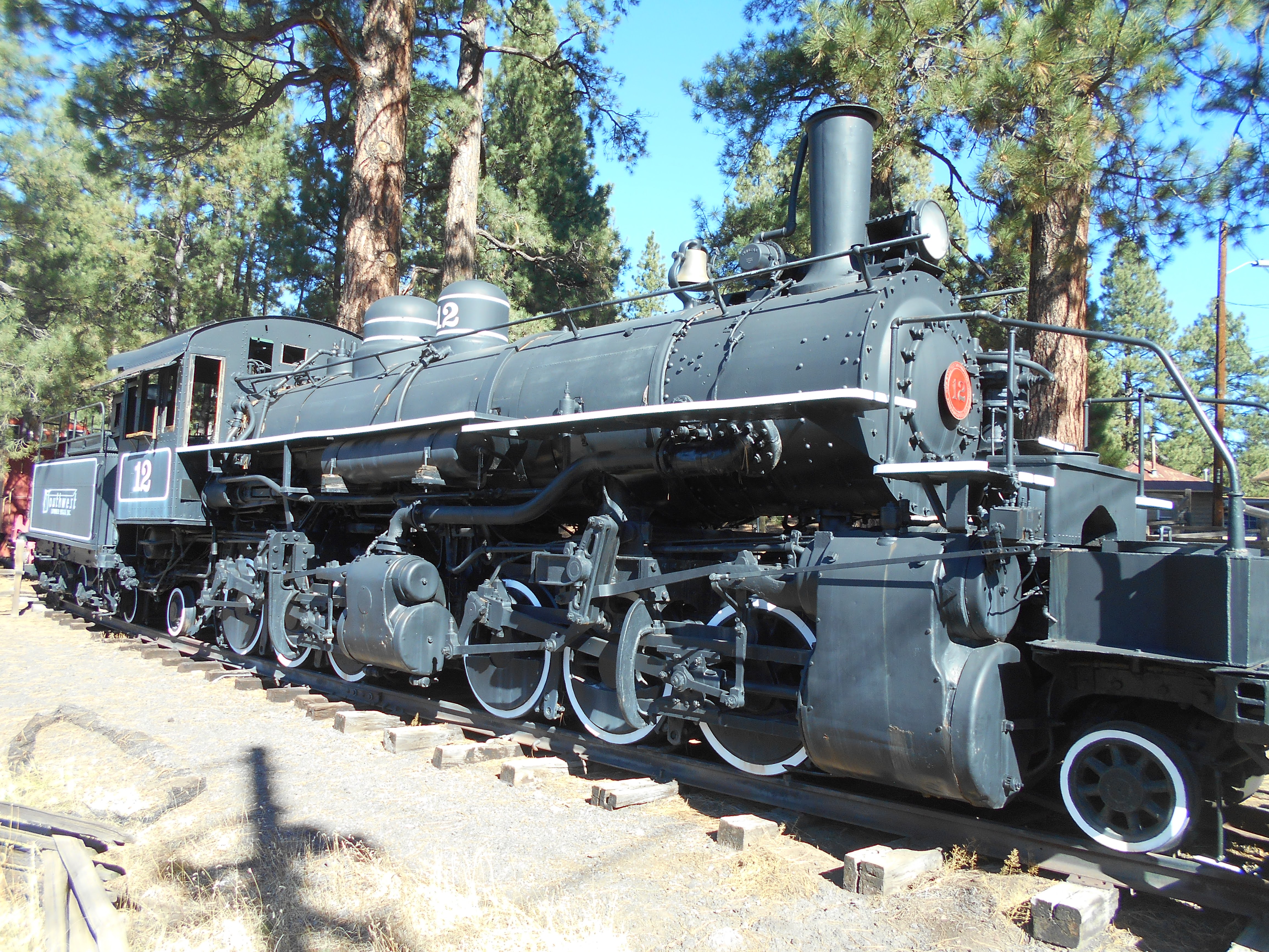
   In October of 1944 the Saginaw and Manistee purchased its' first and only 2-6-6-2 articulated mallet locomotive. Not just any articulate, but a true mallet with high- and low-pressure steam cylinders. It had previously been used in the Pacific Northwest. Later, in 1953, it was sold to Southwest Lumber Mills, then scrapped in 1956 (Schuppert, pages 96, 97.)     

     South-West Lumber Mills took control of the AL&T and the Saginaw lease in 1952-53. The next reorganized company, South-West Forest Industries, ran the line until March of 1966 (Kuhn 1981:101; Glover 1965; Stein, Report #19, page 33.)  

 "NEW LOGGING LINE IN ARIZONA OPENS FOR SERVICE

    Operating the only logging railroad in either Arizona or New Mexico, Saginaw and Manistee Lumber Co. and Southwest Lumber Mills, Inc., both of Flagstaff, Arizona, in May of this year secured the railroad from the Arizona Lumber and Timber Co. It is now about 26 miles long, extending into the Cocconino (sic) National Forest, with eight miles of new line expected to be built this summer. A 2 1/2 mile section was rebuilt to 1 percent eliminating a switchback and 4 percent grades. 

    Longe range plans are to eventually build 75 miles of line in about 20 or 30 years to reach into the companies' timber reserves.

    Motive power at present includes three locomotives, one of which is a shay. The roundhouse is located at the Southwest mill and the shops at the Saginaw mill are being enlarged to handle the railroad equipment." ("The Western Railroader" (published by the Southern California Railroad Club, Volume 6, Number 6 (60); Summer, 1943.) 


    It was hoped that the operations would continue for decades, which it did under new ownership and with a number of changes to the aforementioned plan. The article mentioned additional branch lines and rebuilding of the mainline into the woods. What eventually occurred was the use of trucks to haul the loads to the rail line, and then transporting the logs to to the mill site. Other than a few additions and changes, the main rail feeder remained much the same. I did research on this feeder line several years ago, and there were indications of rebuilding in the rock fill structures. It would be interesting to do further field research and find the switchbacks and old right of way. Another project, for another day.

Observations and Musings: Identifying a Mystery Shay

 Observations and Musings

A Mystery Shay is Revealed


After a short absence, I once again awakened this Blog from its blissful slumber, authoring new posts. There was some urgency in completing the updated engine roster, as the old list was outdated. I am thankful for all of the research by prior scholars who immeasurably helped in documenting this information. Combined with my recent research, I hope to have given them due credit for their prior work. 

I am also thankful for a significant milestone in the number of hits on this Blog. It is now becoming a reference point for research and information on the Saginaw and Manistee Lumber Company of Williams, Arizona. This is not to be confused with other logging railroads that used the same name in different formats, and in separate regions of the country. Thanks to all who have browsed these pages, and making this Blog what it is today. Hopefully, I will get a book published someday...


  Courtesy National Archives, neg. 48-RST-4C-2


  This is a well-known image of Saginaw Southern engines at work, south of Williams. The second engine is often listed as "Unidentified." I can now confidently state that the two engines are two-truck Shay #556, and Shay #212. Both working the line in Barney Flats area, circa 1900. In addition, two-truck Climax #327 was at work in those woods. Like the two Shays, it appears to have the same number as its builder's number.
This may seem to be a minor point; however, it took several years of sleuthing to uncover the second engine's identity. 

The Santa Fe Railway (ATSF) Peavine Route from Ash Fork to Prescott, Arizona: The original grade

 The Santa Fe Railway (ATSF) Peavine Route from Ash Fork to Prescott, Arizona: The original grade (October 2026) Unless otherwise noted, all...